XRP’s Breakout Attempt Turns Into a Bull Trap
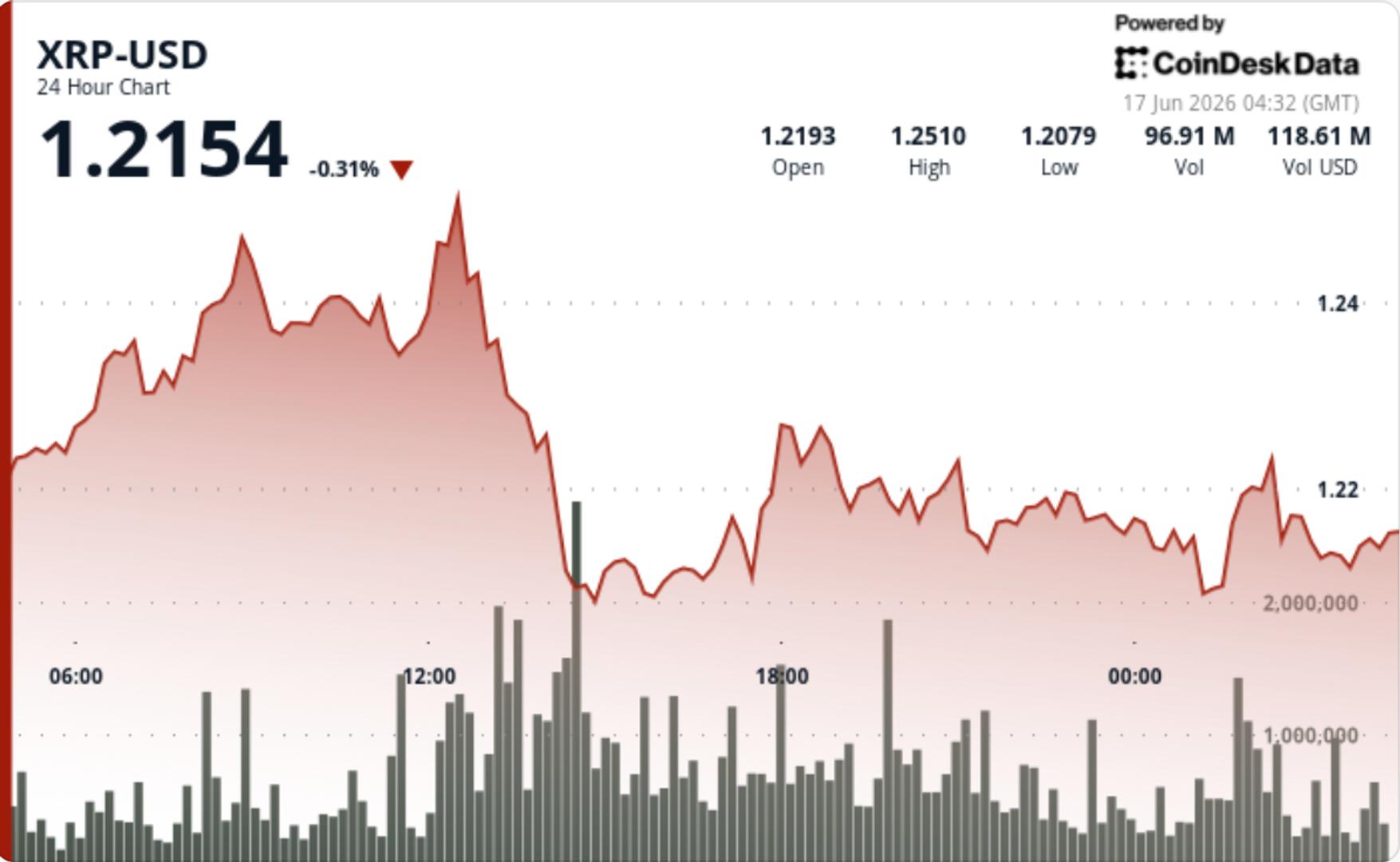
XRP’s move above a key resistance zone has quickly unraveled, with the token slipping back below $1.23 as sellers overwhelmed the breakout. The reversal matters because it was not a quiet pullback. Rising trading volume during the decline suggests the market did not merely pause after a rally; it actively rejected higher prices.
For active traders, that distinction is important. A healthy breakout usually sees price clear resistance, hold the reclaimed level on a retest, and attract fresh demand. XRP did the opposite. It briefly moved through resistance, failed to establish acceptance above it, and then sold off with enough force to erase the breakout gains. That pattern often signals that traders used the strength to reduce exposure rather than chase upside momentum.
Why $1.23 Matters for XRP Traders
The $1.23 area is now the near-term line in the sand. When a token breaks above resistance, that prior ceiling is expected to become support. If price falls back below it quickly, the market sends a clear message: buyers were not strong enough to defend the new range.
For XRP, falling under $1.23 changes the short-term setup from continuation to repair. Bulls now need to reclaim that level with conviction before the breakout thesis becomes credible again. Until then, the market is likely to treat the failed move as overhead supply. Traders who bought the breakout may look to exit near breakeven on any bounce, while short-term sellers may lean into rallies unless volume flips back in favor of buyers.
In practical terms, XRP now has two immediate tests. First, can it stabilize without a deeper flush into the prior consolidation range? Second, can it return above $1.23 and stay there long enough to force sidelined capital back in? A brief wick above the level is not enough. Bulls need sustained trading above resistance, preferably accompanied by expanding spot demand rather than only leveraged activity.
Heavy Selling Volume Is the Bigger Signal
Price slipping below resistance is notable, but the volume profile is what makes this reversal more concerning. When volume rises into a selloff after a breakout, it often reflects distribution. That means larger holders, short-term momentum funds, or leveraged traders may be using liquidity from breakout buyers to offload positions.
This is especially relevant in highly traded large-cap crypto assets like XRP. Because XRP has deep liquidity across major venues, sharp reversals tend to reflect broad participation rather than isolated order book noise. A failed breakout on thin volume can be dismissed as hesitation. A failed breakout on heavy selling is harder to ignore.
The psychology is straightforward. Breakouts attract late buyers, algorithmic momentum strategies, and options-related positioning. If price cannot keep moving higher, those buyers become vulnerable. Once the token falls back below the breakout level, stop-loss orders can trigger, leverage can unwind, and market makers may adjust exposure. That combination can accelerate downside even if the broader long-term narrative remains intact.
Market Context: Major Tokens Are Still Sensitive to Risk Appetite
XRP’s reversal should also be viewed in the broader crypto market context. Large-cap tokens have spent much of the cycle reacting sharply to changes in liquidity expectations, Bitcoin direction, and risk sentiment. Even token-specific strength can struggle when traders are reluctant to add broad altcoin exposure.
For XRP, the challenge is that it sits in a unique category. It has one of the largest and most active retail followings in crypto, strong exchange liquidity, and a long history of news-driven volatility. That makes it attractive to traders, but it also makes it prone to crowded positioning. When a breakout forms, many participants notice it at the same time. If the breakout fails, the exit can become crowded as well.
At roughly the $1.23 price zone, XRP remains a major crypto asset by market value, but its short-term technical structure is now weaker than it appeared during the breakout attempt. The token does not need to collapse for the signal to matter. A failed breakout can simply lead to range-bound trading, lower volatility, or repeated tests of support as the market digests excess positioning.
What Bulls Need to See Next
For the bullish case to recover, XRP needs more than a reflex bounce. The market needs evidence that demand is returning at higher levels. The cleanest constructive sequence would be a move back above $1.23, followed by a successful retest where sellers fail to push price meaningfully lower.
Investors should watch for several signs of improvement:
- Reclaim of $1.23: XRP needs to trade back above the failed breakout zone and hold it for multiple sessions.
- Volume confirmation: Upside moves should be supported by stronger buying volume, not just low-liquidity bounces.
- Higher lows: A series of higher lows would show that buyers are stepping in earlier rather than waiting for deeper discounts.
- Reduced liquidation pressure: Stabilization in leveraged markets would suggest forced selling is fading.
- Relative strength: XRP should outperform peer large-cap altcoins if the breakout thesis is regaining traction.
Without these signals, rallies may remain vulnerable. In failed breakout environments, the first bounce is often driven by short covering and bargain hunting, not durable accumulation. That is why confirmation matters.
What Bears Are Watching
For sellers, the setup is simple: keep XRP below $1.23 and force the market to accept that the breakout failed. If price remains capped under that level, traders may begin targeting lower support zones within the prior range. The longer XRP trades below former resistance, the more that level can transform into a ceiling.
Bears will also watch whether downside volume continues to expand. If every bounce is met with selling and volume spikes on red candles, it would suggest distribution is ongoing. Conversely, if selling pressure fades and price compresses near $1.23, the bearish edge weakens. Failed breakouts can reverse again, but only when sellers run out of momentum and buyers reclaim control.
Another risk for bulls is leverage. XRP often attracts derivatives activity because of its liquidity and volatility. If traders piled into long positions during the breakout, a move lower can trigger cascading liquidations. That does not necessarily reflect a change in long-term fundamentals, but it can create short-term technical damage that takes time to repair.
Investor Strategy: Do Not Confuse Volatility With Confirmation
For educated retail investors, the lesson is not that XRP is broken. It is that breakouts require confirmation. Buying immediately after a resistance break can work in strong trend environments, but failed breakouts are among the most common traps in crypto trading. Waiting for a retest, watching volume, and defining invalidation levels can reduce the risk of entering into exit liquidity.
Longer-term XRP holders may view the pullback differently from short-term traders. If the investment thesis is based on adoption, liquidity utility, or broader market cycles, a drop below $1.23 may not change the core view. But even long-term investors benefit from understanding technical structure, because weak breakouts can offer better entry points later or warn against adding too aggressively into resistance.
Traders should also avoid assuming that one failed breakout guarantees a deeper selloff. Markets can recover quickly when liquidity returns. The key is discipline: if XRP reclaims $1.23 with strong demand, the failed signal weakens. If it cannot, the path of least resistance shifts toward consolidation or further downside.
Key Takeaway
XRP’s slide below $1.23 after a brief breakout is a meaningful short-term warning. The move suggests sellers used the rally to reduce exposure, and the rise in selling volume makes the rejection more significant than a routine pullback. Bulls now need to reclaim $1.23 and hold it with convincing demand to repair the chart.
Until that happens, XRP remains vulnerable to choppy trading and potential downside tests. The long-term story may still attract believers, but the near-term message is clear: momentum has stalled, resistance has reasserted itself, and traders should wait for confirmation before treating the breakout as alive again.