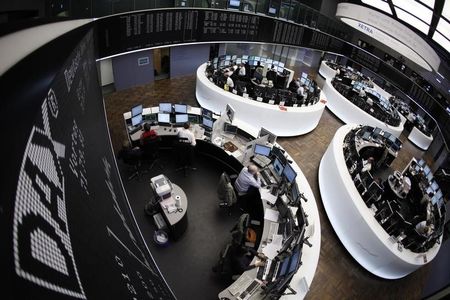
Europe Tries to Regain Its Balance After a Risk Shock
The STOXX 600 is attempting to find a floor after a sudden geopolitical shock triggered its steepest selloff in months, jolting investors out of the low-volatility mindset that had dominated much of the recent market narrative. For currency traders, this is not just an equity story. European stocks are a key barometer of global risk appetite, capital flows, bank confidence, and expectations for European growth. When a broad benchmark such as the STOXX 600 suffers a sharp rout, the repercussions often travel quickly into the euro, Swiss franc, yen, dollar, and commodity-linked currencies.
The immediate question is whether the decline is a one-day repricing of geopolitical risk or the start of a deeper de-risking cycle. The answer will depend less on the headline shock itself and more on how energy prices, bond yields, credit spreads, and corporate earnings expectations respond over the next several sessions. A market can absorb bad news when liquidity is deep and policy expectations are stable. It struggles when the shock threatens growth, inflation, and financial conditions at the same time.
Why the STOXX 600 Matters Beyond Equities
The STOXX 600 is Europe’s broadest major equity benchmark, covering large, mid, and smaller companies across the region. That makes it more informative than a narrow national index because it captures banks, insurers, industrial exporters, luxury groups, healthcare leaders, utilities, energy producers, and consumer companies in a single risk gauge. A sharp fall in this index typically signals a broad reassessment of earnings, financing conditions, and investor appetite for European exposure.
For forex markets, the index matters because Europe is heavily integrated into global trade and energy supply chains. A geopolitical shock that threatens shipping routes, commodity flows, or regional security can quickly raise risk premia. Investors may reduce European equity exposure, hedge euro-denominated assets, or shift cash toward safe-haven currencies. This is why a STOXX rout can coincide with pressure on EUR/USD, volatility in EUR/CHF, and demand for the U.S. dollar and Japanese yen.
The Euro’s Problem: Growth Risk Versus Inflation Risk
The euro’s reaction to geopolitical stress is often complicated. If the shock is seen as primarily hurting European growth, the euro tends to weaken because markets price a softer economic outlook and a more cautious European Central Bank. If the shock also raises energy prices, however, the ECB faces a harder trade-off: inflation risks rise even as growth risks worsen. That mix is uncomfortable for both policymakers and investors.
Europe remains more sensitive than the United States to imported energy and external demand. Even though the region has improved its resilience since the energy crisis earlier in the decade, natural gas and crude oil still matter for household purchasing power, industrial margins, and current-account dynamics. A sustained rise in energy costs would act like a tax on consumers and manufacturers. That is typically negative for the euro, particularly against the dollar, which benefits from safe-haven flows and the United States’ relatively stronger domestic energy position.
Retail investors should watch whether EUR/USD weakness is driven by equity outflows alone or confirmed by widening yield differentials. If U.S. Treasury yields hold firm while German Bund yields fall on safe-haven demand and growth concerns, the interest-rate channel reinforces euro downside. If Bund yields rise because energy-driven inflation fears dominate, the FX signal becomes messier and volatility can increase.
Safe Havens Are Back in Focus
The most reliable early response to geopolitical turbulence is renewed interest in safe-haven currencies. The Swiss franc usually benefits when European investors seek regional safety, though Swiss authorities have historically been sensitive to excessive franc strength. The Japanese yen can also attract haven demand, especially if global yields fall and carry trades are unwound. The U.S. dollar, meanwhile, remains the world’s primary liquidity hedge when investors cut risk broadly.
These flows can be especially powerful if they collide with crowded positioning. In calm markets, investors often borrow low-yielding currencies to fund purchases of higher-yielding or riskier assets. When volatility jumps, those trades can reverse abruptly. That is why yen crosses, including EUR/JPY and GBP/JPY, can move sharply during equity selloffs. A STOXX 600 rout does not automatically mean a lasting yen rally, but it increases the probability of short, violent unwinds in carry-sensitive pairs.
Sector Signals: Banks, Energy, and Defense
Inside the STOXX 600, sector performance will provide important clues about the durability of the selloff. Banks are particularly important for FX because they reflect confidence in credit conditions and the economic cycle. If European banks remain under pressure, the market is likely worried about weaker loan demand, tighter financial conditions, or a broader hit to growth. That would typically weigh on the euro and cyclical currencies.
Energy shares may behave differently. If oil and gas prices rise on supply concerns, energy producers can outperform even as the broader market falls. But that does not necessarily make the macro picture healthier. Higher energy prices can support sector earnings while damaging consumers and import-heavy economies. Defense stocks may also attract bids during geopolitical uncertainty, but leadership from defensive or security-linked sectors often signals capital preservation rather than genuine risk appetite.
- Banks: watch for signs of credit stress and growth pessimism.
- Energy: outperformance may reflect inflation pressure, not economic strength.
- Industrials and autos: weakness can signal concern about trade, exports, and supply chains.
- Luxury and consumer shares: pressure may point to fading global discretionary demand.
- Utilities and healthcare: relative resilience often suggests defensive rotation.
Bond Markets Will Decide Whether This Is a Dip or a Regime Shift
Equity investors often look at price levels for support, but macro traders look at the bond market. If the geopolitical shock pushes investors into German Bunds, U.S. Treasuries, and other high-quality sovereign debt, yields may decline and financial conditions may stabilize. That would support the argument for a short-term equity correction rather than a deeper bear phase. However, if yields rise because markets fear a renewed inflation impulse from energy or supply disruptions, equities could face a more difficult adjustment.
The key is whether risk-off behavior is disinflationary or inflationary. A growth scare that lowers yields can eventually help equities by making future earnings more valuable and encouraging central banks to lean dovish. A supply shock that lifts inflation while hurting activity is far more dangerous. In that environment, central banks have less room to cushion markets, and currencies tied to energy importers often suffer.
What Retail Investors Should Watch Next
For educated retail investors, the temptation after a sharp rout is to focus only on whether the index bounces. A better approach is to track confirmation across markets. A credible stabilization in the STOXX 600 should be accompanied by calmer currency volatility, narrower credit spreads, contained energy prices, and reduced demand for havens. If equities bounce while EUR/CHF keeps falling, oil keeps rising, and bank shares remain weak, the recovery may be fragile.
Important indicators include EUR/USD around major technical zones, EUR/CHF as a gauge of European stress, Brent crude and European natural gas benchmarks, German Bund yields, and volatility indices tied to European equities. The behavior of U.S. futures also matters. Europe rarely stabilizes in isolation if Wall Street is aggressively de-risking. Conversely, a firm U.S. session can help European investors rebuild confidence the following day.
Bottom Line
The STOXX 600’s attempt to find footing after its biggest rout in months is a major test of global risk sentiment. For forex markets, the selloff raises three central questions: whether the euro faces a growth shock, whether energy prices revive inflation pressure, and whether safe-haven demand becomes persistent. A quick rebound is possible if the geopolitical shock is contained and bond markets remain orderly. But if the stress spreads into credit, energy, and bank shares, the move could become more than a temporary equity correction.
The most important message for investors is not to treat this as a single-index story. European equities, the euro, safe-haven currencies, and energy markets are now trading as one macro complex. Until those signals align toward stability, caution is warranted. A durable recovery will require more than bargain hunting; it will require evidence that the shock is not undermining Europe’s growth outlook or reigniting the inflation risks that central banks have spent years trying to contain.