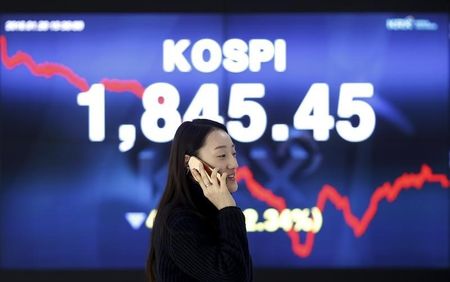
Korea’s Tech Selloff Finds a Floor
South Korea’s equity market staged a meaningful recovery after a sharp technology-led drawdown that erased roughly 10% from key chip and hardware names. The rebound in Samsung Electronics and SK Hynix helped steady the broader KOSPI, easing fears that the region’s semiconductor rally was turning into a deeper risk-off correction.
The move is important because Korea is not just another Asian equity market. It is one of the world’s cleanest listed proxies for the global semiconductor cycle, artificial intelligence infrastructure spending, memory pricing, and export demand. When Samsung and SK Hynix fall hard, the signal travels quickly through Asian equities, the Korean won, Taiwan dollar, Japanese yen crosses, and even broader emerging-market risk appetite.
Wednesday’s recovery suggests investors are distinguishing between a violent positioning unwind and a fundamental breakdown. After a 10% wipeout in tech, bargain hunters returned to the market, with traders reassessing whether the selling had overshot near-term earnings risks.
Why Samsung and SK Hynix Drive the KOSPI
The KOSPI is unusually exposed to a small number of globally important technology exporters. Samsung Electronics remains Korea’s most influential listed company, while SK Hynix has become an increasingly central player in high-bandwidth memory, a critical component for AI accelerators and data-center expansion.
That concentration cuts both ways. In bullish phases, foreign inflows into Korean technology can lift the entire index and support the won. In selloffs, weakness in these names can quickly become a national equity-market event.
The recent plunge was particularly significant because it came after an extended period of enthusiasm around AI infrastructure demand. Investors have been paying premium valuations for firms tied to memory chips, advanced packaging, cloud capex, and data-center buildouts. Any concern about margin pressure, order timing, geopolitical restrictions, or stretched positioning can therefore trigger outsized volatility.
Still, the rebound indicates that the market is not ready to abandon the semiconductor cycle. Memory pricing has been recovering from its previous downcycle, AI-related demand remains structurally strong, and Korean exporters continue to benefit from their dominant role in global supply chains. The key debate is not whether semiconductors matter, but how much good news was already priced in.
The FX Angle: Korean Won Sensitivity Is Rising
For currency traders, the KOSPI rebound is especially relevant because the Korean won is one of Asia’s most cyclical currencies. USD/KRW tends to rise when foreign investors sell Korean equities, global chip demand looks shaky, or dollar liquidity tightens. It tends to fall when export expectations improve, equity inflows resume, and risk appetite strengthens.
A stabilization in Samsung and SK Hynix can therefore reduce pressure on the won, particularly if foreign funds step back into Korean equities. In practical terms, a tech rebound may translate into lower USD/KRW upside momentum, although the currency remains sensitive to broader dollar trends and U.S. rate expectations.
The won’s reaction also matters for neighboring currencies. Korea, Taiwan, and Japan sit at the center of the global electronics supply chain. When Korean chip shares recover, traders often reassess exposure to the Taiwan dollar, Japanese yen, and offshore yuan. A calmer KOSPI can support regional risk appetite, while renewed selling would likely revive demand for defensive dollar positions.
- USD/KRW: Most directly affected by Korean equity flows and export expectations.
- USD/TWD: Sensitive to parallel moves in semiconductor sentiment and foreign portfolio flows.
- JPY crosses: Influenced by broader risk appetite, carry trades, and Asian equity volatility.
- USD/CNH: Often reflects regional growth confidence and China-linked supply-chain sentiment.
What Triggered the Wipeout?
A 10% drawdown in major technology names rarely has a single cause. More often, it reflects a combination of stretched positioning, valuation anxiety, macro repricing, and profit-taking. In this case, the selloff appears consistent with a market that had become heavily concentrated in the AI and semiconductor narrative.
When investors crowd into the same theme, even modest disappointments can cause exaggerated price action. Concerns may include whether AI server demand can keep growing at current rates, whether memory margins are near peak momentum, whether U.S. technology restrictions could broaden, or whether global rates remain too high for long-duration growth assets.
Another factor is foreign ownership. Korean equities are deeply integrated into global portfolios, meaning international investors can quickly reduce exposure when volatility rises. That makes the KOSPI vulnerable to global de-risking even when domestic fundamentals remain intact.
The rebound, however, suggests forced selling may have eased. Markets often stabilize when short-term traders cover positions and longer-term investors begin separating structural winners from overbought momentum trades.
Bank of Korea and Macro Implications
The Bank of Korea faces a delicate backdrop. A weaker won can raise imported inflation pressures, particularly through energy and food channels, while slowing domestic demand argues against overly restrictive policy. Equity volatility adds another layer because Korea’s household and corporate confidence are closely tied to financial-market conditions.
If the KOSPI recovery holds and the won stabilizes, policymakers gain breathing room. A calmer currency reduces pressure to defend against imported inflation, while resilient tech exports support growth. But if the rebound fails and USD/KRW pushes higher, the central bank may need to sound more cautious, especially if dollar strength is broad-based.
For investors, this means the KOSPI bounce is not only an equity story. It affects expectations around rate cuts, capital flows, and Korea’s external balance. A strong semiconductor export cycle generally improves Korea’s trade position, which can support the won over time. Conversely, a tech-led equity unwind can undermine confidence before export data visibly deteriorates.
Risk Sentiment Across Asia
The recovery in Korean tech also has implications for Asia-wide risk sentiment. Regional markets have become increasingly tied to the AI supply chain, with investors looking across Korea, Taiwan, Japan, and parts of Southeast Asia for beneficiaries of cloud infrastructure and electronics demand.
If Samsung and SK Hynix continue to rebound, the message to markets is that the AI trade may be bruised but not broken. That would favor cyclical Asian equities and reduce immediate demand for safe-haven dollar positions. It could also revive interest in carry trades funded in lower-yielding currencies, though yen volatility remains a key constraint.
If the bounce fades, the interpretation changes sharply. A failed rebound after a 10% wipeout would imply investors are selling rallies rather than buying dips. That could pressure the won, weigh on regional chip shares, and encourage a broader defensive rotation into the U.S. dollar, gold, and lower-beta assets.
What Retail Investors Should Watch Next
For educated retail investors, the next phase is about confirmation. A single rebound is encouraging, but not enough to prove that the correction is over. The most important signals will come from price action, foreign flows, earnings commentary, and currency behavior.
- KOSPI breadth: A healthy recovery should extend beyond Samsung and SK Hynix into broader exporters and financials.
- Foreign investor flows: Sustained buying would strengthen the case for won stabilization.
- USD/KRW direction: A falling pair would confirm improved Korea risk appetite; renewed upside would warn of lingering stress.
- Memory pricing and guidance: Comments on high-bandwidth memory demand and margins will shape the next leg.
- U.S. dollar trend: Even strong Korean fundamentals can be overwhelmed by broad dollar strength.
The key is to avoid treating the rebound as an all-clear signal. Semiconductor cycles can be powerful, but they are also volatile. Investors should separate long-term structural demand from short-term valuation risk.
Bottom Line
The KOSPI’s recovery after a 10% technology wipeout is a significant relief signal for Asian markets. The rebound in Samsung and SK Hynix suggests investors are not abandoning Korea’s semiconductor story, even after a sharp correction in crowded AI-linked trades.
For forex markets, the Korean won is the main transmission channel. Continued strength in chip shares would likely support regional risk appetite and limit USD/KRW upside. A failed rebound, however, would revive concerns about foreign outflows, stretched valuations, and broader Asian equity weakness.
The immediate takeaway is that Korea’s tech sector remains a high-beta barometer for global risk. When Samsung and SK Hynix stabilize, the effect reaches far beyond Seoul. It influences currency flows, emerging-market sentiment, and the market’s confidence in the durability of the AI-driven semiconductor cycle.