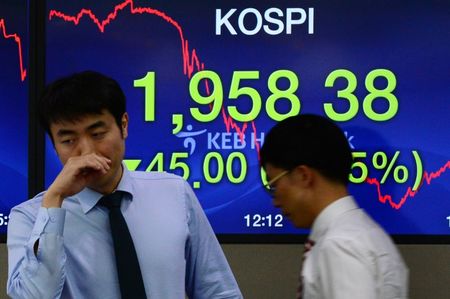
A Chip-Led Shock Hits Seoul
South Korea’s equity market was jolted after sharp semiconductor losses triggered a sidecar trading halt, a circuit-breaker style mechanism designed to slow automated selling when futures markets move too violently. The move immediately put global investors on alert because the KOSPI is not just a domestic benchmark. It is one of the world’s most concentrated expressions of the semiconductor cycle, the artificial intelligence hardware boom, Asian export demand and global risk appetite.
The pressure was led by the chip complex, where heavyweight names such as Samsung Electronics and SK Hynix dominate index direction. When these stocks fall together, the KOSPI has limited room to absorb the shock. The benchmark’s structure means a selloff in memory, high-bandwidth memory, foundry and advanced packaging names can quickly become a market-wide event, even if banks, autos or consumer shares are not the original problem.
What the Sidecar Signal Really Means
A sidecar in South Korea is typically triggered when the KOSPI 200 futures market moves beyond a specified threshold for a sustained period, temporarily restricting program trading to prevent mechanical selling from overwhelming the cash market. It is not merely a technical footnote. It signals that futures-led pressure has become intense enough for market structure protections to activate.
For investors, the message is clear: this was not ordinary profit-taking. A sidecar event suggests rapid de-risking, forced hedging or algorithmic selling linked to index futures. These mechanisms often appear when traders are trying to reduce exposure faster than the underlying cash market can comfortably process. That makes the event important beyond Korea, particularly for funds holding Asia ex-Japan equities, emerging market ETFs, semiconductor baskets and AI infrastructure trades.
Why Semiconductors Matter So Much to Korea
Korea is unusually exposed to the semiconductor cycle. Chips account for a major share of exports, drive a significant portion of corporate earnings and influence the Korean won through trade expectations. Samsung Electronics and SK Hynix alone can represent more than a quarter of KOSPI market capitalization at various points in the cycle. That concentration amplifies both upside and downside.
The AI boom has made this sensitivity even more pronounced. Investors have rewarded companies tied to HBM chips, advanced DRAM, NAND recovery, data center demand and Nvidia-linked supply chains. But when expectations become crowded, even a modest doubt about pricing, capex, margins or customer demand can spark an outsized move. In a market that has already priced in strong multi-year AI demand, the burden of proof shifts from possibility to delivery.
The latest halt therefore reflects a broader question: has the AI semiconductor trade become too dependent on perfect execution? Investors are no longer debating whether AI demand exists. They are debating whether the current valuation premium fully discounts that demand, whether supply growth is catching up, and whether hyperscale spending can keep expanding without margin pressure or budget discipline.
Possible Catalysts Behind the Selloff
While a single session rarely has one clean cause, chip-driven market stress usually comes from a cluster of concerns. Several themes are likely weighing on sentiment:
- Valuation fatigue: Semiconductor shares have enjoyed powerful gains tied to AI infrastructure, leaving them vulnerable to crowded-position unwinds.
- Memory pricing risk: Investors may be questioning whether DRAM and NAND pricing momentum can continue if supply additions accelerate.
- HBM competition: High-bandwidth memory remains a premium market, but competitive pressure and qualification risk can shift earnings expectations quickly.
- Global tech repricing: Any weakness in U.S. mega-cap technology or AI hardware names tends to transmit rapidly into Korea.
- Currency and rates pressure: A weaker won or higher global yields can intensify foreign investor selling in export-heavy equity markets.
The key is that chip stocks are both cyclical and narrative-driven. They trade on inventory cycles, capex plans and pricing data, but also on long-term themes such as AI compute scarcity. When short-term data and long-term enthusiasm diverge, volatility can rise sharply.
Why Global Investors Should Care
The KOSPI’s halt is a useful stress test for the global AI trade. Korea sits upstream in the hardware supply chain. If investors are selling Korean chipmakers aggressively, they may also reassess adjacent exposures, including Taiwanese foundries, Japanese semiconductor equipment makers, U.S. AI server suppliers and global cloud capex beneficiaries.
It also matters for emerging market sentiment. South Korea is often treated as a high-beta proxy for global manufacturing and technology demand. When Korean equities break lower, it can pressure broader Asia risk assets, especially if foreign investors are the marginal sellers. The Korean won may also weaken during equity outflows, which can create a feedback loop: currency weakness raises foreign-exchange risk, prompting additional equity selling from global funds.
For cross-asset traders, the watchlist expands beyond Seoul. A chip-led KOSPI selloff can influence Nasdaq futures, the Philadelphia Semiconductor Index, Taiwan’s Taiex, Japanese tech exporters and even copper or industrial metals if the move is interpreted as a broader growth signal. Conversely, if the event proves to be a positioning shakeout rather than a fundamental break, dip buyers may quickly test whether AI-linked demand remains the dominant market narrative.
How to Interpret the Move: Crash Signal or Reset?
Investors should avoid assuming that every trading halt marks the start of a deeper bear market. Sidecar events are designed to cool disorderly markets, not predict long-term direction. However, they do reveal stress beneath the surface. The most important question is what happens after the halt: do buyers return, does volume normalize, and do market leaders stabilize?
A constructive interpretation would be that the market is flushing out leveraged positions after an extended rally. If semiconductor earnings revisions remain positive, HBM demand remains robust and export data continues to improve, the pullback could reset valuations without damaging the broader uptrend. In that scenario, quality chip leaders may regain support once volatility fades.
A more negative interpretation would be that investors are beginning to price a peak in AI hardware optimism. If memory prices soften, customers delay orders or major technology buyers signal slower capital expenditure growth, the KOSPI could face a more durable rerating. The danger for investors is that semiconductor downturns often move from stock prices to earnings forecasts with a lag. Shares can fall before analysts cut estimates.
What Retail Investors Should Watch Next
For educated retail investors, the response should be disciplined rather than emotional. A trading halt creates headlines, but the investable signal lies in follow-through. The next few sessions will determine whether this was a volatility spike or a regime shift.
- Foreign investor flows: Persistent selling by offshore funds would suggest broader de-risking rather than local panic.
- Samsung and SK Hynix leadership: Stabilization in these names is essential for the KOSPI to recover.
- Korean won movement: Currency weakness can amplify equity losses for foreign holders.
- U.S. semiconductor performance: If U.S. chip stocks also weaken, the issue is global, not Korea-specific.
- Export and earnings guidance: Hard data will matter more than narrative after a volatility shock.
Investors with exposure to Korea or semiconductor ETFs should review concentration risk. Many technology and emerging market products carry more chip exposure than investors realize. The same theme that powered returns can become the source of sudden drawdowns when momentum reverses.
Bottom Line
The KOSPI trading halt is a warning that the AI and semiconductor trade is entering a more fragile phase. It does not automatically invalidate the long-term case for advanced chips, memory demand or Korea’s role in global technology supply chains. But it shows that positioning, valuation and market structure can turn a sector selloff into a benchmark-level shock.
For now, the event should be treated as a risk sentiment alarm rather than a standalone local market story. If chip leaders stabilize and global tech remains firm, the halt may be remembered as a painful but temporary reset. If selling spreads across semiconductor supply chains and earnings expectations begin to fall, it could mark the start of a broader reassessment of the AI hardware boom.