A Local Equity Shock With Global FX Consequences
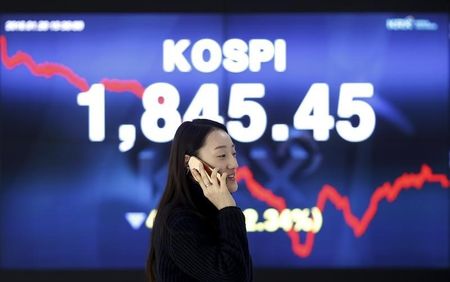
South Korea’s equity market delivered one of the clearest risk-off signals in Asia as the KOSPI slid more than 8%, triggering a market-wide circuit breaker. The move was not merely a bad session for local stocks. South Korea sits at the intersection of global technology supply chains, semiconductor demand, export momentum, and foreign portfolio flows. When Korean equities fall this sharply, the currency market pays attention.
The immediate read-through is straightforward: investors are reducing exposure to high-beta technology assets, cutting regional risk, and reassessing the outlook for the Korean won. For forex traders, an 8% collapse in the benchmark equity index is important because it often coincides with foreign selling, hedging demand, and pressure on USD/KRW. The KOSPI is heavily influenced by large-cap technology and semiconductor names, so a sharp drop signals anxiety about the global earnings cycle, not just domestic Korean conditions.
Korea’s circuit breaker system is designed to halt trading temporarily when losses reach extreme thresholds, giving markets time to process information and reducing disorderly selling. But while the halt may slow the pace of liquidation, it does not erase the underlying message: investors are questioning whether tech valuations, earnings expectations, and liquidity conditions can still support recent positioning.
Why Korean Tech Matters Beyond Seoul
South Korea is one of the world’s most important technology exporters. Its large listed companies are deeply tied to memory chips, smartphones, displays, batteries, artificial intelligence infrastructure, and consumer electronics. That makes the KOSPI a practical barometer for the health of global tech demand.
When Korean tech stocks are under stress, the market is often worried about one or more of the following:
- Semiconductor cycle risk: Investors may be pricing in weaker chip pricing, slower demand growth, or disappointing guidance from major producers.
- AI trade fatigue: If investors have crowded into artificial intelligence-linked supply chains, even small disappointments can trigger large unwinds.
- Export sensitivity: Korea’s economy is highly exposed to global trade, especially demand from the United States, China, and broader Asia.
- Valuation compression: High-growth technology shares are vulnerable when discount rates rise or earnings momentum slows.
- Foreign investor flows: Overseas investors can dominate marginal pricing in Korean equities, creating pressure on both stocks and the won when they sell.
This is why an equity circuit breaker in Seoul can influence screens in Singapore, Taipei, Tokyo, New York, and London. Korea is not a closed domestic story. It is a liquid, globally integrated market with strong links to both the dollar cycle and the Asian export complex.
The Korean Won Is the First FX Pressure Point
The most direct forex impact is on USD/KRW. In risk-off environments, the won usually weakens because foreign investors selling Korean equities often need to convert proceeds into dollars. At the same time, local investors and corporates may increase hedges against further currency depreciation.
The won is also a cyclical currency. It tends to perform well when global trade is expanding, chip demand is firm, and risk appetite is strong. It tends to struggle when investors fear a slowdown, a tech earnings correction, or tighter global financial conditions. An 8% KOSPI drop therefore reinforces the currency’s vulnerability, especially if the selloff is accompanied by rising U.S. yields, a stronger dollar, or falling regional equity indices.
For traders, the key question is whether the move in USD/KRW becomes a disorderly breakout or remains a contained adjustment. South Korean authorities have historically monitored excessive won volatility closely. Direct verbal warnings, smoothing operations, and coordination with local institutions are possible when currency moves become abrupt. However, intervention can slow depreciation more easily than it can reverse a broad global risk-off wave.
The Bank of Korea faces a delicate policy backdrop. If the won weakens sharply, imported inflation pressures can rise, particularly through energy and raw materials. But if equity losses deepen and confidence deteriorates, the domestic growth outlook may weaken. That tension limits how aggressively policymakers can lean in either direction.
Regional Contagion: TWD, JPY, CNH and AUD in Focus
The spillover risk is not limited to Korea. A severe decline in Korean tech shares can pressure other Asia-linked currencies and equity markets. The Taiwan dollar is an obvious comparison because Taiwan is also central to the semiconductor supply chain. If investors interpret the KOSPI plunge as a warning about chips rather than a Korea-specific shock, TWD may face similar outflow pressure.
The Chinese yuan can also be affected through trade and sentiment channels. Korea’s exporters are highly linked to Chinese demand, and weakness in Korean markets can reinforce concerns about Asia’s manufacturing cycle. If USD/CNH rises alongside USD/KRW, it would suggest a broader dollar-positive Asia risk-off trade rather than isolated Korean stress.
The Japanese yen is more complicated. In classic risk-off episodes, the yen can benefit as carry trades unwind. But if Japanese equities are also under pressure and U.S. yields remain elevated, yen strength may be uneven. The market will watch whether USD/JPY falls because of safe-haven demand or rises because the dollar is broadly dominant.
The Australian dollar may also react because it is often used as a liquid proxy for China and Asian growth sentiment. If the KOSPI selloff feeds fears of weaker regional demand, AUD/USD could come under pressure even though Australia is not directly part of the Korean tech complex.
What the Circuit Breaker Tells Investors About Positioning
Circuit breakers are rarely triggered by ordinary disappointment. They tend to appear when positioning is crowded, liquidity is thin, or investors are forced to reduce risk quickly. The size of the KOSPI decline suggests the market was vulnerable to a feedback loop: falling prices trigger stop-loss selling, margin calls, fund redemptions, and volatility-control deleveraging.
This matters because modern markets are heavily influenced by systematic strategies. Risk-parity funds, volatility-targeting models, and leveraged portfolios can all reduce exposure when volatility spikes. That mechanical selling can turn a fundamental concern into a sharper market move, particularly in sectors where foreign ownership is high and investor expectations were optimistic.
For retail investors, the mistake would be to treat the circuit breaker as either automatically catastrophic or automatically a buying opportunity. Extreme price moves can create value, but they can also be early warnings that earnings estimates and macro assumptions are about to be revised lower. The distinction depends on whether the selloff is liquidity-driven, fundamentals-driven, or both.
Signals to Watch Over the Next 48 Hours
Several indicators will determine whether this becomes a contained local shock or a broader regional stress event:
- USD/KRW follow-through: A sustained move higher would confirm currency-market concern and foreign outflow pressure.
- Foreign equity flow data: Continued net selling by offshore investors would keep pressure on both the KOSPI and the won.
- KOSDAQ performance: Smaller and growth-oriented technology shares can reveal whether stress is spreading beyond blue chips.
- Semiconductor peers: Weakness in Taiwan, U.S. chip stocks, and Japanese tech suppliers would suggest a global sector repricing.
- Credit spreads: If corporate credit begins to widen, the shock is moving from equities into funding conditions.
- Policy communication: Statements from financial authorities or the central bank can help stabilize sentiment if investors believe liquidity support is credible.
The most constructive scenario would be a rapid stabilization in USD/KRW, limited foreign selling after the halt, and a rebound in major semiconductor names. The more concerning scenario would be persistent won weakness, heavy foreign outflows, and synchronized selling across Asian tech markets.
How Investors Should Think About the Trade
For forex traders, the initial bias is typically dollar-positive against the won until evidence of stabilization appears. However, chasing USD/KRW after a large move carries risk because Korean authorities may step in verbally or operationally if depreciation becomes excessive. Traders should also watch U.S. rates: if Treasury yields are rising at the same time as Asian equities fall, the dollar impulse is much stronger.
For equity investors, the key is separating world-class franchises from cyclical exposure. Korean technology leaders can be structurally strong while still facing deep cyclical drawdowns. Valuation discipline matters. A stock that looked cheap after a 15% correction may not be cheap if earnings estimates fall 25%.
For diversified portfolios, the event is a reminder that Asian tech exposure can be highly correlated during stress. Owning Korea, Taiwan, Japan, and U.S. semiconductor names may feel geographically diversified, but the underlying factor may be the same: global technology capex and chip demand.
Bottom Line
The KOSPI’s 8% plunge and circuit breaker trigger mark a major risk-off moment for Asian markets. Because South Korea is deeply tied to global technology and export cycles, the selloff has implications far beyond local equities. The Korean won is the key FX pressure point, with USD/KRW likely to remain sensitive to foreign equity flows, tech sentiment, and dollar strength.
The next phase depends on whether the shock remains a liquidity-driven unwind or evolves into a broader reassessment of semiconductor earnings and Asian growth. For now, investors should treat the move as a warning that crowded tech positioning and fragile macro confidence can collide quickly. Stabilization is possible, but confirmation must come from currency markets, foreign flows, and the performance of regional tech peers.