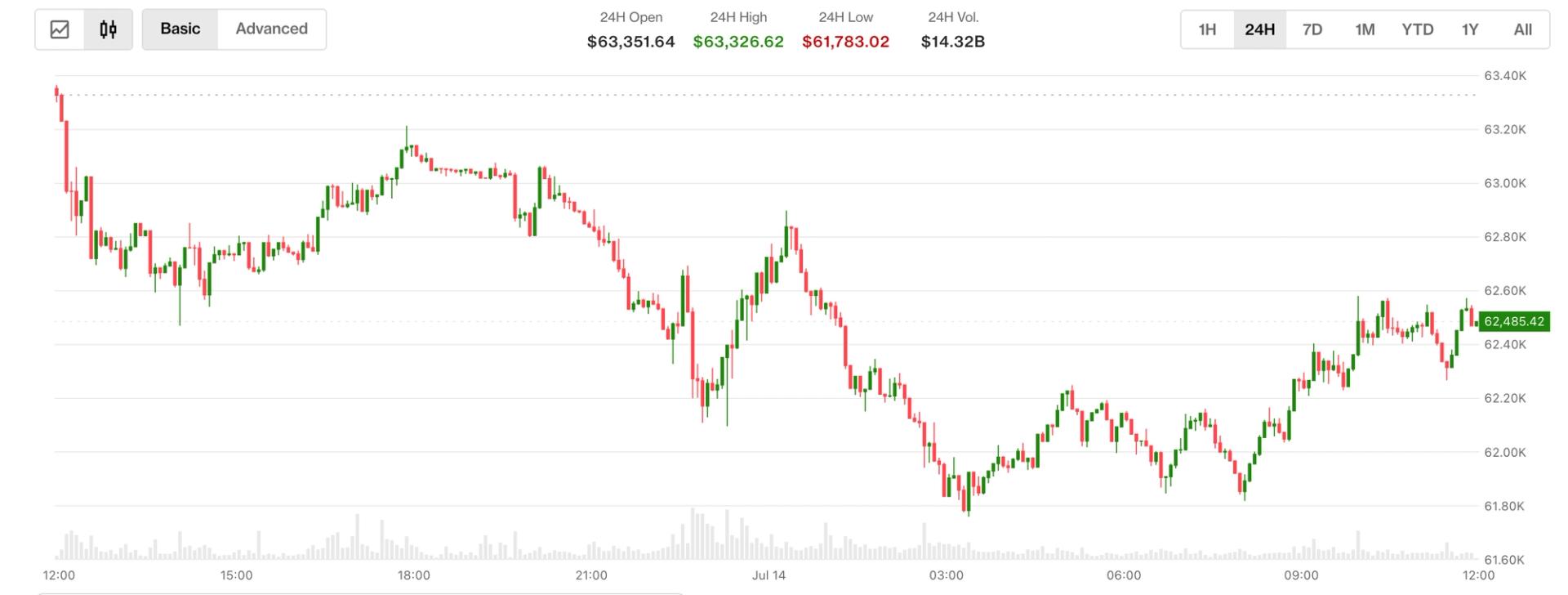
What is driving Bitcoin lower ahead of the inflation report?
Bitcoin is falling because traders are increasing bets that the Federal Reserve could raise interest rates at its July meeting, just as the market awaits a key inflation report. Major cryptocurrencies have dropped by 2% or more in 24 hours, showing that the move is not isolated to Bitcoin but part of a broader risk-asset repricing.
The decline reflects a familiar macro pattern: when inflation risk rises, policy-rate expectations rise, liquidity expectations fall, and speculative assets lose support. Crypto remains one of the most liquidity-sensitive corners of global markets, so even a modest shift in Fed expectations can produce an outsized reaction in Bitcoin, Ether, Solana, and high-beta altcoins.
For much of the current cycle, Bitcoin has traded as both a long-duration asset and a liquidity hedge. When investors expect easier monetary conditions, they are more willing to pay up for assets with no yield but strong scarcity or growth narratives. When they expect tighter policy, cash and Treasury bills become more competitive, leverage becomes more expensive, and crypto’s risk premium expands.
The timing matters. The market is heading into an inflation release that could either validate or defuse concerns that price pressures are re-accelerating. Traders do not need certainty to reduce exposure; they only need enough risk that the next data point could force a policy repricing. That is why Bitcoin can weaken before the report rather than after it.
How do Fed rate hike bets pressure crypto prices?
Fed rate hike bets pressure crypto by raising the expected return on cash, increasing funding costs, and reducing appetite for volatile assets. A potential 25-basis-point hike may look small on paper, but it can shift the entire risk curve if traders believe it signals a longer period of tight policy.
Bitcoin does not have earnings, dividends, or coupon payments. Its valuation depends heavily on liquidity, adoption expectations, balance-sheet flows, and investor confidence in its long-term monetary properties. When short-term interest rates rise, investors can earn more in low-risk instruments, which increases the hurdle rate for holding an asset like Bitcoin.
The effect also travels through derivatives. Crypto markets are heavily influenced by perpetual futures, options positioning, and margin financing. If macro traders start buying downside protection or cutting long exposure ahead of the inflation report, market makers often hedge by selling spot or futures. That mechanical flow can deepen short-term losses, especially during thin liquidity windows.
There is also a leverage channel. Higher rate expectations can strengthen the U.S. dollar and lift real yields, both historically difficult backdrops for crypto rallies. A stronger dollar reduces global purchasing power for dollar-priced assets, while higher real yields make non-yielding assets less attractive. Bitcoin can still rally in such conditions if idiosyncratic demand is strong, but the bar becomes higher.
- Higher policy rates: make cash and Treasury yields more attractive versus speculative assets.
- Higher real yields: reduce the appeal of non-yielding stores of value such as Bitcoin and gold.
- Stronger dollar: can pressure global crypto demand by tightening financial conditions.
- More expensive leverage: lowers risk-taking across futures, options, and margin accounts.
- Volatility repricing: encourages traders to hedge or reduce exposure before macro events.
Why does the inflation report matter for Bitcoin traders?
The inflation report matters because it is the clearest near-term input into whether the Fed can stay patient or must tighten again. If headline or core inflation comes in hotter than expected, July rate hike odds could rise further and keep pressure on Bitcoin.
For crypto traders, the most important details are not only the headline inflation number but the composition. Markets tend to focus on core inflation, which strips out volatile food and energy prices, because it better reflects underlying price pressure. Sticky services inflation, wage-sensitive categories, and shelter costs can matter more than a one-month move in gasoline or food prices.
A cooler report would likely weaken the rate-hike narrative and could spark a relief rally, particularly if Bitcoin is already oversold on short-term timeframes. In that scenario, traders may unwind defensive hedges, perpetual funding could normalize, and high-beta tokens could rebound faster than Bitcoin. However, relief rallies after macro data can fade quickly if the broader policy message remains restrictive.
A hotter report is more dangerous because it would confirm the market’s new caution. If inflation surprises to the upside, traders may price not only a July hike but also a more hawkish path into the following meetings. That would challenge the bullish assumption that monetary conditions are moving toward easing rather than renewed tightening.
The key for Bitcoin is whether inflation changes the liquidity outlook. Crypto does not need zero rates to perform, but it usually needs confidence that conditions are not tightening faster than expected. A surprise that pushes real yields higher and the dollar stronger can force systematic funds, macro desks, and leveraged retail traders to cut risk at the same time.
Is this a normal pullback or the start of a deeper crypto correction?
A 2% to 3% daily decline in major cryptocurrencies is normal by crypto standards, but the catalyst makes this pullback important. When the selloff is driven by Fed repricing rather than crypto-specific news, it can spread broadly and persist until the macro uncertainty clears.
Bitcoin’s structure should be evaluated across three layers: spot demand, derivatives positioning, and macro liquidity. If spot buyers step in near key support while derivatives leverage cools, the market can reset without major damage. If spot demand fades and long liquidations accelerate, a routine pullback can become a deeper correction.
Retail investors should also recognize that Bitcoin often leads the market during macro stress. Altcoins typically carry higher beta, meaning they can fall more sharply when Bitcoin weakens and liquidity tightens. Tokens linked to narratives such as artificial intelligence, gaming, restaking, or memecoins may see amplified moves because their valuations rely even more on risk appetite than on cash-flow fundamentals.
Still, this is not automatically a bearish long-term signal. Bitcoin has repeatedly absorbed macro shocks during larger adoption cycles. Institutional participation, spot ETF demand in major markets, corporate treasury interest, and the halving-driven supply narrative can all provide structural support. The issue is time horizon: long-term scarcity arguments can remain intact while short-term traders still face a painful repricing.
What should traders watch next?
Traders should watch the inflation print, the market-implied probability of a July Fed hike, the U.S. dollar, real yields, and crypto derivatives positioning. Bitcoin’s next meaningful move will likely depend on whether the data confirms or challenges the tightening narrative.
The most important signal after the inflation report will be the reaction, not just the number. If Bitcoin rallies on a soft print but fails to hold gains, it may indicate that sellers are using macro relief to exit positions. If Bitcoin falls on a hot print but quickly recovers, it may suggest that the market had already priced in a hawkish outcome.
Funding rates can provide another clue. Elevated positive funding during a selloff indicates that longs may still be crowded and vulnerable. Negative or neutral funding after a decline can show that leverage has been flushed, creating better conditions for stabilization. Options markets are also important; rising demand for puts signals traders are paying up for downside insurance.
Spot ETF flows, where applicable, remain a useful gauge of institutional demand. Persistent inflows can cushion macro-driven selling, while outflows can amplify weakness. On-chain data such as exchange balances and long-term holder behavior can also help separate short-term speculative selling from deeper distribution.
For educated retail investors, the practical takeaway is to avoid treating every dip as the same. A pullback caused by a protocol exploit, regulatory action, or token unlock has a different risk profile from one caused by Fed expectations. Macro-driven moves can reverse quickly after data, but they can also cascade if the data shifts the entire policy path.
Key Takeaway
Bitcoin’s latest slide is a macro-driven repricing tied to rising July Fed rate hike bets ahead of a crucial inflation report, with major cryptocurrencies down at least 2% in 24 hours. A cooler inflation print could trigger relief, but a hotter reading would likely strengthen the higher-rate narrative and keep pressure on crypto. For traders, the key is not just the CPI number but how rates, the dollar, yields, and derivatives positioning respond immediately afterward.