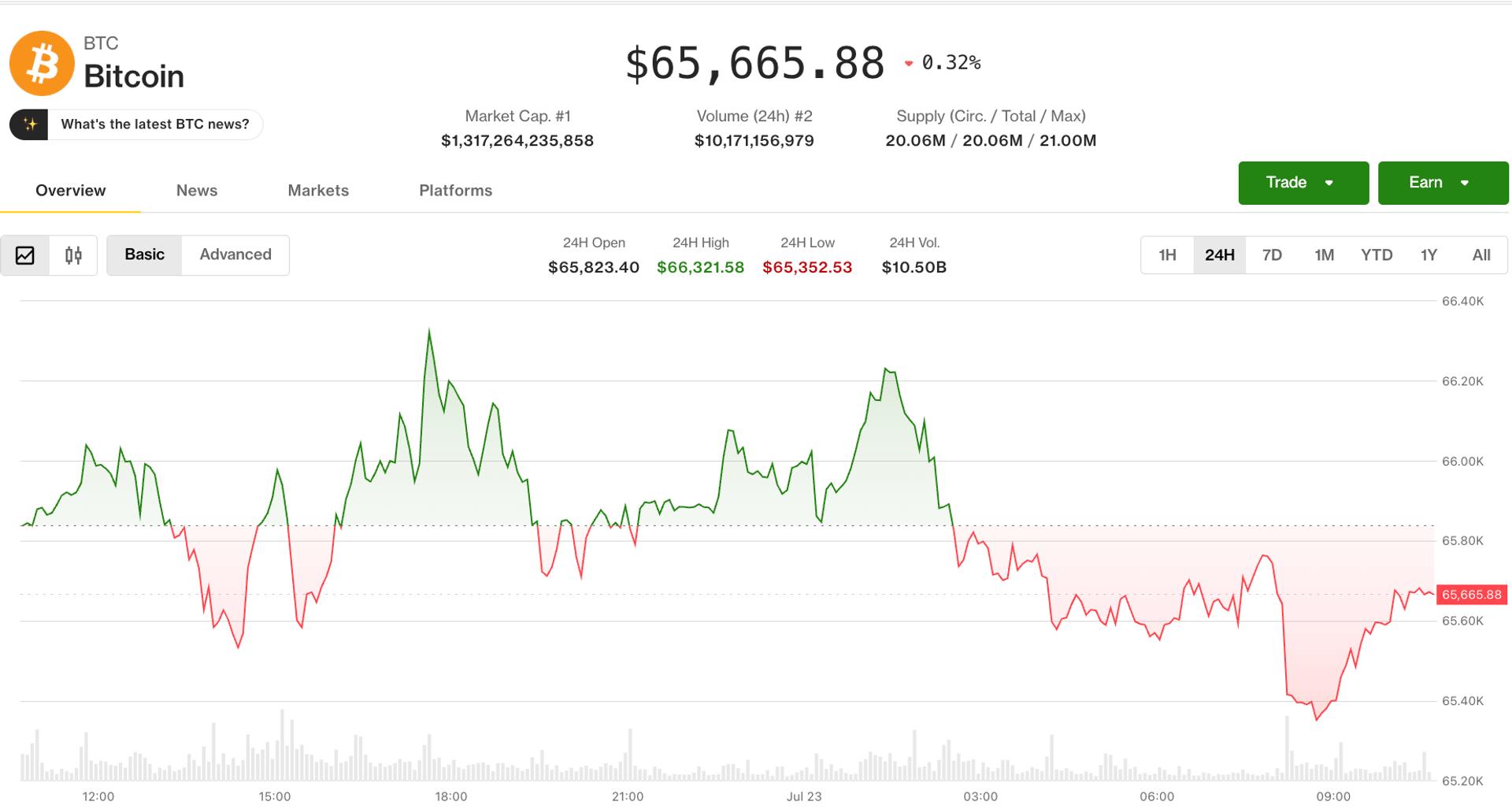
What is driving Bitcoin’s current holding pattern?
Bitcoin is consolidating after a sharp July rebound, trading in a tight band between $64,000 and $66,800. That range follows a roughly 13% recovery from the month’s lows, a move that has improved sentiment without yet convincing traders that a fresh trend leg has begun.
The setup is classic mid-rally digestion: momentum cooled as buying pressure met overhead supply, while macro markets offered few decisive clues. In that environment, traders are leaning on short-term range trading rather than chasing breakouts, and that naturally compresses volatility.
For Bitcoin, the key point is that the market has not rolled over. Instead, it has paused. That matters because pauses after impulsive moves often reset positioning and allow leveraged longs to unwind before the next directional attempt.
Why does Bitcoin’s range matter for traders?
The current range matters because it defines the immediate battlefield for both momentum traders and risk managers. A clean move above $66,800 could invite trend followers back in, while a loss of $64,000 would suggest the July rally is failing to attract sustained demand.
In practical terms, the market is signaling balance. Bulls have defended the rebound, but they have not yet forced a decisive breakout. Bears, meanwhile, have not been able to reclaim control, which is why the price has remained boxed in despite an otherwise constructive monthly recovery.
That balance often leads to a liquidity-driven move once a catalyst arrives. Because Bitcoin sits at the center of the crypto complex, any sharp break in BTC usually spills into altcoins, stablecoin flows, and derivatives positioning almost immediately.
How does a post-rally consolidation usually work?
A consolidation phase usually happens when a market needs time to absorb gains. After a strong move higher, early buyers may take profits, late buyers may hesitate, and fresh capital waits for confirmation before committing.
That dynamic can produce a narrow range even when the broader trend remains constructive. In Bitcoin’s case, a 13% rebound is enough to attract attention, but not enough to remove uncertainty about whether the move was a short-covering bounce or the start of a larger recovery.
- Support zone: Around $64,000, where buyers have so far shown willingness to defend the move.
- Resistance zone: Near $66,800, where rallies have slowed and supply has reappeared.
- Market signal: Compression, not capitulation, which keeps the next breakout in play.
This kind of setup often favors patience over prediction. Traders who wait for confirmation typically want either a strong daily close above resistance or a failed breakdown that quickly reclaims support.
What is macro doing to Bitcoin right now?
Macro conditions are offering little near-term direction, and that is part of why crypto has settled into a holding pattern. When equities, rates, and the dollar are all moving without a clear theme, Bitcoin often mirrors the broader indecision rather than leading it.
The lack of macro conviction reduces the odds of a sustained risk-on impulse, but it also limits downside pressure. In other words, Bitcoin is not getting the strong external tailwind that can fuel a breakout, yet it is also not facing a macro shock large enough to force a sharp repricing.
For traders, this means the next meaningful move is likely to come from either a technical break in BTC itself or a surprise shift in macro expectations. Until then, the market is likely to remain selective and tactical.
Why are altcoins like WLFI moving while Bitcoin stays flat?
When Bitcoin pauses, capital often rotates into higher-beta names looking for faster returns. That is one reason WLFI stood out in the session with a 12% gain, even as BTC stayed rangebound.
Altcoin outperformance during Bitcoin consolidation is a familiar pattern. Traders who expect BTC to stay stable for a while may take on more risk in smaller tokens, especially those with strong narrative momentum, thinner liquidity, or event-driven catalysts.
However, those moves can cut both ways. A strong single-session gain in an altcoin does not necessarily signal a broader trend; it can simply reflect speculative positioning in a thinly traded asset. Still, such pockets of strength are worth watching because they can reveal where risk appetite is rebuilding first.
What should investors watch next?
The most important question now is whether Bitcoin can convert its rebound into a higher high. That will depend on whether spot demand improves and whether derivatives markets stop capping upside with profit-taking and hedging activity.
Investors should watch for several signals that could break the current standoff:
- Volume expansion: A breakout is more credible if it comes with rising spot volume.
- Funding and open interest: Overheated leverage can stall rallies; a cleaner setup often follows a reset.
- Macro catalysts: Any move in rates, inflation expectations, or the dollar could reprice crypto quickly.
- Cross-asset confirmation: Strength in equities and high-beta assets would support a renewed risk-on move.
If Bitcoin pushes above the top of the range with conviction, it could re-anchor bullish sentiment across the market. If it fails and slips back under support, the July recovery may be viewed as a relief rally rather than the start of a larger uptrend.
Bottom Line
Bitcoin’s current holding pattern is not a bearish signal by itself; it is a consolidation phase after a meaningful 13% July rebound. The market is waiting for either a technical breakout above $66,800 or a breakdown below $64,000 to determine the next major move.
For traders, this is a market to watch closely rather than force. The pause in BTC may be temporary, but the eventual resolution is likely to shape direction across the wider crypto market.