
Bitcoin is no longer "approaching" $60,000.
It has broken below it.
On 24 June, BTC fell to roughly $59,300 and touched an intraday low near $59,100 after trading above $63,000 earlier in the day. That is a brutal move in a few hours, but the important part is not the percentage drop. It is what the breakdown means.
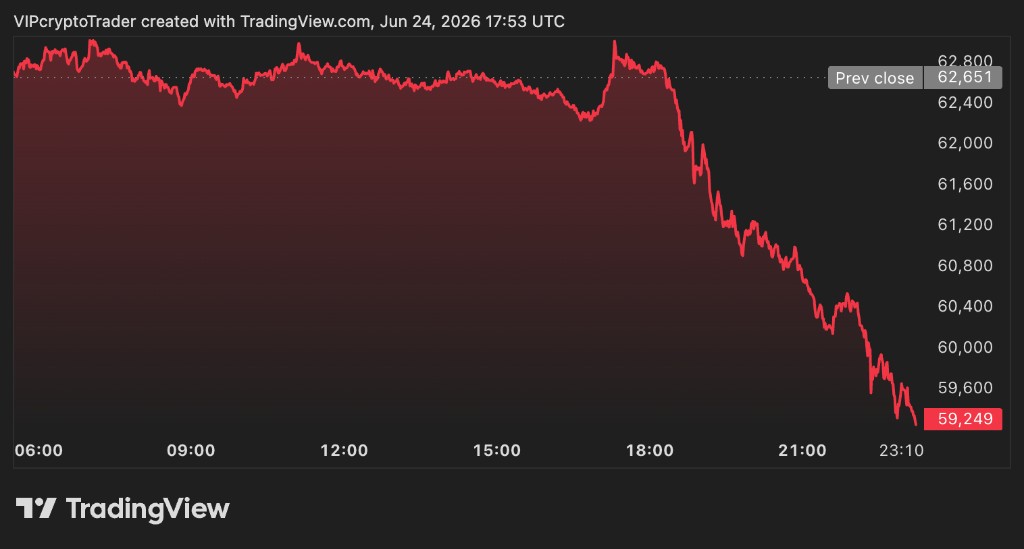
For weeks, $60,000 was treated as Bitcoin's safety rail. Buyers were expected to show up there. Traders built positions around it. Options markets clustered around it. Commentators kept calling it "major support."
Now that level is under pressure.
And when a major support level stops behaving like support, the market does not ask whether Bitcoin is cheap. It asks where the next real buyer lives.
This Is Not a One-Headline Crash
Bitcoin is falling because several sources of support have weakened at the same time.
The cleanest signal is institutional demand.
US spot Bitcoin ETFs recorded approximately $172 million in net outflows on 22 June, followed by another $113.8 million in outflows on 23 June. That means nearly $286 million left these products in two sessions.
That matters because ETF flows are not just a number on a dashboard. They are the modern version of spot demand. When ETFs are taking in capital, Bitcoin can absorb selling pressure. When they are bleeding, there is less natural demand waiting below the market.
At the moment, Bitcoin is not only dealing with sellers. It is dealing with the absence of serious buyers.
The Fed Is Still Not Bitcoin's Friend
The Federal Reserve has kept rates at 3.5%–3.75% and remains focused on inflation. That is not an environment built for easy speculation.
Bitcoin tends to perform best when liquidity is loose, the dollar is weak, and investors are willing to take risk. Right now, the market is getting the opposite message.
Inflation remains elevated. The dollar is firm. Investors are waiting for the next US PCE inflation release. And the Federal Reserve has made it clear that price stability matters more than giving markets the rate cuts they want.
That does not mean Bitcoin cannot rally. But it does mean every rally needs a real reason. A green candle without fresh ETF buying, improving macro data, or a weaker dollar is not a recovery. It is just a bounce.
Bitcoin Is Losing the "Risk Asset" Trade and the "Hard Asset" Trade
There is another uncomfortable reality. Bitcoin is not currently benefiting from risk-on behaviour. Capital is still flowing into AI, semiconductors, major technology companies, and upcoming IPO narratives. Bitcoin has lost some of its position as the market's favourite high-volatility growth bet.
At the same time, gold and oil have also weakened as the old "debasement trade" unwinds. That leaves Bitcoin in an awkward position.
It is not winning as a risk asset. And it is not winning as a hedge against fiat weakness either. That is why this decline feels heavier than a normal technical pullback.
The Strategy Story Is a Sentiment Problem, Not a Supply Problem
Strategy's Bitcoin sale was small in actual market terms. Thirty-two BTC is not enough to crash Bitcoin. But markets do not only trade size. They trade belief.
Strategy was seen as one of Bitcoin's most predictable buyers. The company's financing pressure and the weakness in its preferred shares have created a new fear: what happens if one of Bitcoin's biggest corporate accumulation machines cannot keep buying at the same pace?
That does not mean Strategy is about to dump its holdings. It is not the core reason Bitcoin is falling. But it weakens a narrative that helped support the market: the idea that a large corporate buyer would always be there underneath BTC.
Options Expiry Can Make This Move More Violent
A major Bitcoin options expiry is due on 26 June. More than $10 billion worth of BTC options are set to expire, and the $60,000 strike has become one of the most important levels in the market.
This does not guarantee that Bitcoin will fall further. But it does mean price can become unstable around key strikes. When options are heavily positioned around a level and price breaks through it, market makers hedge, traders cut positions, stops get triggered, and liquidity can disappear quickly.
Markets do not fall like elevators. They fall like staircases with trapdoors. Bitcoin is currently standing on one.
So, How Low Can Bitcoin Fall?
There is no honest analyst who can give you one exact bottom number. Anyone telling you Bitcoin will "definitely bottom at $55,000" or "cannot go below $60,000" is selling certainty that does not exist. The better way to look at this is through downside zones.
Zone 1: $58,000–$59,000 — Current Battlefield
Bitcoin is already testing this area. If BTC quickly reclaims $60,000 and closes above it, this could become a failed breakdown — the first constructive sign. But if Bitcoin continues closing below $59,000, the market will likely stop treating this as a dip and start treating it as a breakdown.
Zone 2: $55,000–$56,500 — Most Realistic Next Downside Target
This is the first major downside zone to watch if $59,000 fails decisively. It is close enough to attract dip buyers, large enough to trigger liquidations, and important enough to become the next market-wide psychological level.
$55K–$56.5K is the first zone where Bitcoin may finally find a serious attempt at support. Not $40,000. Not zero. Not some dramatic apocalypse number.
Zone 3: $51,500–$53,000 — Deeper Correction Scenario
If Bitcoin loses $55,000 and ETF outflows continue, the next meaningful zone is around $52,000. This would represent a more serious correction, not just a temporary flush. For Bitcoin to reach this area, the market would likely need a combination of:
- Continued ETF redemptions
- A stronger US dollar
- Hot inflation data
- Weak technology stocks
- No recovery in spot demand
- Continued fear around corporate BTC buyers and leveraged positions
This is not the base case today. But it is a very real risk if $55,000 breaks.
Zone 4: $48,000–$50,000 — Tail-Risk Scenario
This is not the primary forecast. It is the stress scenario. Bitcoin would likely need a true macro shock, a sharp deterioration in risk assets, persistent institutional selling, and a complete failure of the $52,000 area to reach this zone.
The market should not ignore it. But traders should not trade as if it is guaranteed either. The mistake is always the same: people become bullish at the top because they think nothing can go wrong, then become bearish at the bottom because they think nothing can recover. Both are emotional mistakes.
What Would Turn This Around?
Bitcoin does not need a miracle. It needs evidence.
The first sign of stability would be a reclaim of $60,000 followed by a move back above $63,000–$64,000 with strong volume. The stronger confirmation would be a move above $65,000, because that would show that buyers are willing to step back into the market — not merely bouncing off oversold conditions.
The most important non-chart signal remains ETF flows. One green ETF flow day is not enough. But two or three consecutive positive days, especially with BlackRock's IBIT showing meaningful inflows, would change the tone quickly.
The other major catalyst is US inflation data. If PCE inflation comes in softer than expected, the market may start pricing less pressure from the Federal Reserve — helping risk assets broadly, including Bitcoin. If inflation surprises higher, Bitcoin may not get the relief rally traders are hoping for.
What Should Traders Do Now?
For futures traders, this is a capital-preservation market. Do not increase leverage simply because Bitcoin is down. A falling market can remain oversold longer than a leveraged position can remain open. Do not blindly average into longs below broken support. Let Bitcoin prove that $59,000 can hold. If it cannot, respect the possibility of $55,000.
For spot buyers, avoid going all-in at one price. A better approach is to keep cash available and scale only when the market starts showing actual support — not when social media starts shouting "buy the dip."
For long-term holders, the important question is not whether Bitcoin is red today. It is whether your position size matches your risk tolerance. If a 10%–15% further decline would force you into panic, the position may be too large.
Final Take
Bitcoin is not falling because its long-term story is dead. It is falling because the market has lost confidence in the short-term support system. ETF demand is weak. Macro remains restrictive. The dollar is firm. The options market is approaching a major expiry. And Bitcoin has now broken below the level everyone was watching.
The most likely immediate downside target is $55,000–$56,500 if Bitcoin cannot regain $60,000 quickly. A deeper move toward $52,000 becomes realistic only if that zone fails and institutional demand does not return.
For now, this is not a market that rewards excitement. It rewards patience, smaller sizing, and waiting for proof.
This article is for educational purposes only and is not financial advice.